
Why India’s Youthful "Cockroaches" Demand a Soulful Reform in Education
Mahatma Gandhi · July 23, 2026
Written in the fictional voice of Mahatma Gandhi. AI Disclosure.
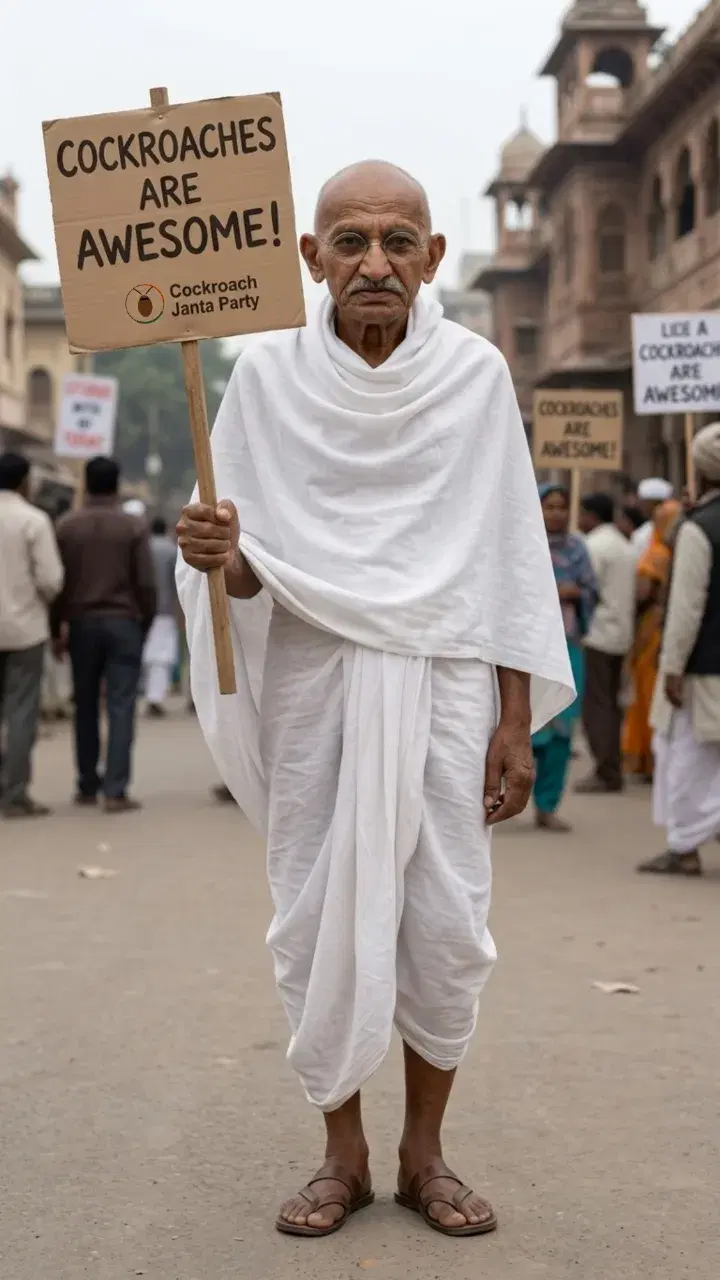
My dear friends, when I look at the streets of New Delhi today, my heart both swells with pride and aches with a familiar sorrow. Our youth, organized under the wonderfully eccentric banner of the Cockroach Janta Party, have taken to Jantar Mantar to demand truth and transparency in India's government and national examinations. To see the young rise up for justice is a beautiful thing. But to see their peaceful march met with lathis, barricades, and tear gas on the road to Parliament is a tragedy that reminds me of a past I fought so hard to leave behind.
The grievances of India's students are deeply rooted. The shocking leaks in the 2026 NEET exam paper have not just compromised a test; they have compromised the dreams of millions of young minds who toil day and night. For weeks, young leaders like Abhijeet Dipke have led peaceful sit-ins, and our brave brother Sonam Wangchuk has endured a grueling 24-day hunger strike, a quiet sacrifice that has now seen him moved to hospital. Yet, instead of receiving these students with open arms and listening ears, the authorities chose the path of coercion, leading to a violent clash on July 20 where hundreds of students and security personnel were injured. When the state treats its own children as adversaries, it forgets that a government’s true strength lies not in its batons, but in its capacity to listen.
How do we mend this fractured trust? We must return to the spirit of Satyagraha—not merely as a tool of protest, but as a framework for governance. First, Education Minister Dharmendra Pradhan and the administration must step away from their high pedestals and sit directly on the ground with these student leaders. True compromise is not a sign of weakness; it is the ultimate proof of democratic strength. I also propose a decentralized council of students, teachers, and independent observers who oversee the examination boards. Let us replace the sterile, hyper-centralized testing machinery with a system of local accountability, where the community itself guards the sanctity of learning. We must cultivate a culture of mutual trust rather than treating education as a high-stakes lottery that drives our children to despair.
An eye for an eye will only make the whole world blind, and a lathi for a protest will only deafen the ears of the state. Let the government withdraw its police force, open its doors for a genuine dialogue, and honor the sacrifices of those who fast. The future of India does not lie in violence, but in securing the hearts and minds of our youth through respectful dialogue.